Avoid one client dominating your cash flow by aiming for each client to make up only around 20% of your income. Anything over 50% is a red flag and a sign to find more clients, reallocate your hours and make sure you have enough cash saved up to cover the gap if the client doesn't renew their contract.
Are you lying awake at night, caught in a spiral of doom with the same three questions on repeat:
"What if my biggest client cancels their contract?"
"What if I can't find another contract in time?"
"What if I can't pay my rent?"
Well, my friend, welcome to the club!
It's almost a rite of passage to go through the epic highs and lows of running your own business. Once you've cut ties with the safety of a traditional 9-to-5, all the responsibility (and the bills) are on your shoulders.
The fix? Yanking out the ye olde calculator and running the numbers.
All you need is a plan to prepare for the worst-case scenario, and if it happens, your stress levels will hit a 3 or 4 instead of a world-ending 10.
Here's everything you need to know about protecting your business's cash flow, and the strategies you can rely on to keep one client from turning into a night terror and ruining your sleep score.
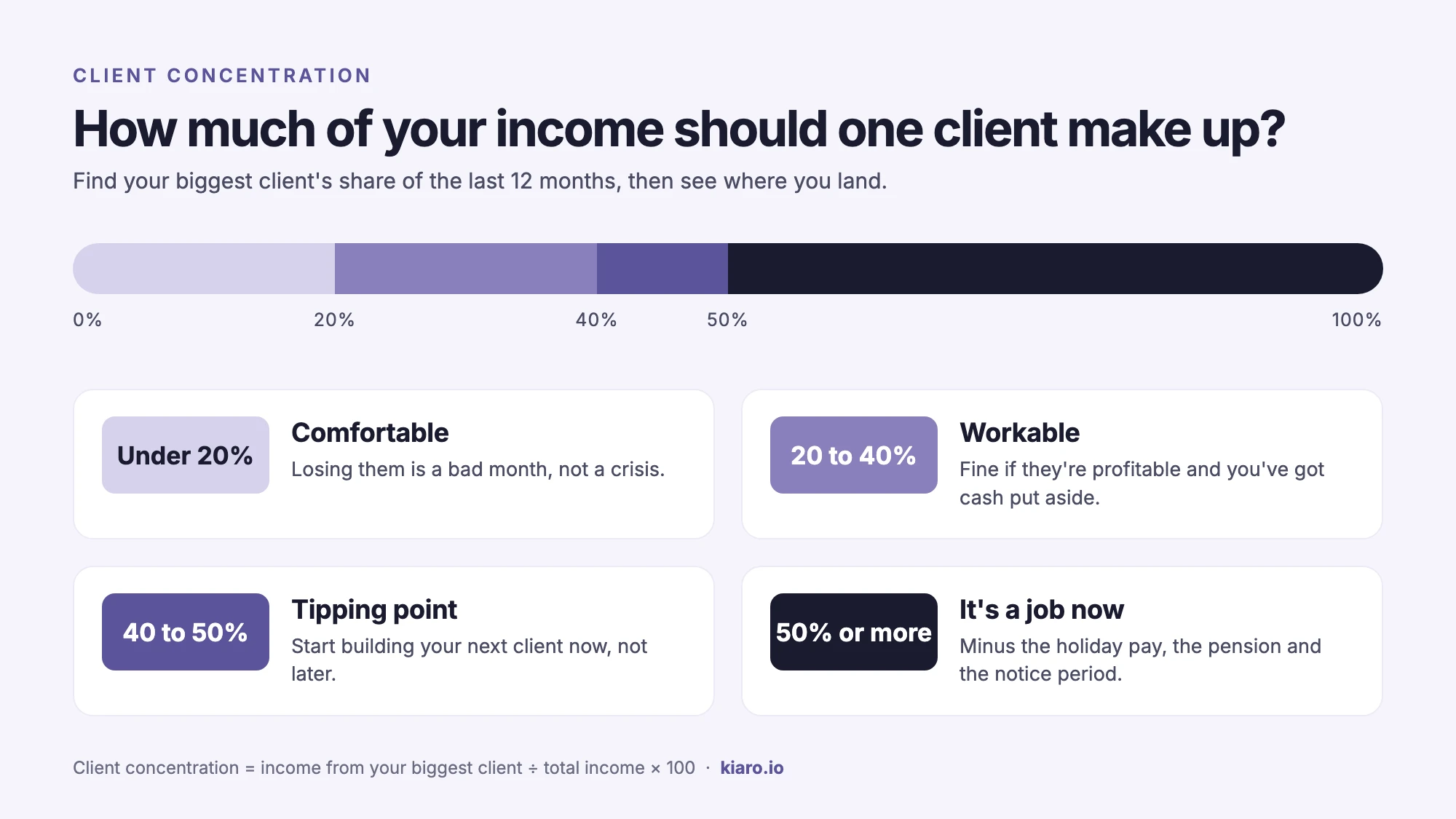
What percentage of your income should one client make up?
In our experience, the sweet spot is under or around 20%.
With each account only taking up a small slice of the pie, it's not detrimental if you lose a piece and there's still plenty more pie to go around until you find a new client.
But it's also not a hard rule.
You might find somewhere between 20% and 40% workable as long as the client is profitable and you've stashed cash away to stay afloat while your income stabilises.
However, 50%? That's a major red flag.
Once you enter this zone, you're no longer consulting or freelancing. You have a full-time job minus the paid time off, retirement fund and notice period.
Yikes.
It only takes one budget cut or a new hire deciding your services aren't worth it for you to lose half your income. Instantly.
Read more: Invoice-to-Cash Churn Warning System: Signals to Track and Fix First
How do you work out how much of your income comes from one client?
There are two methods you can use:
- Some good 'ol manual calculator maths
- Our free client concentration calculator
For option one, you want to look at your income over the last 12 months, work out how much you've earned from each client to work out your client concentration risk:
Client concentration = (income from your biggest client ÷ total income) × 100
For example, if you're billing $150,000 a year, and your biggest client is a $6,000 a month retainer, worth $72,000 a year, your calculation would look like this:
$72,000 ÷ $150,000 × 100 = 48%
For the second option, pop your numbers into the calculator. Add how much each client has paid you over the last 12 months (and their hours, if you track them), and it tallies up each client's percentage for you.
When you're done, it can look something like this:
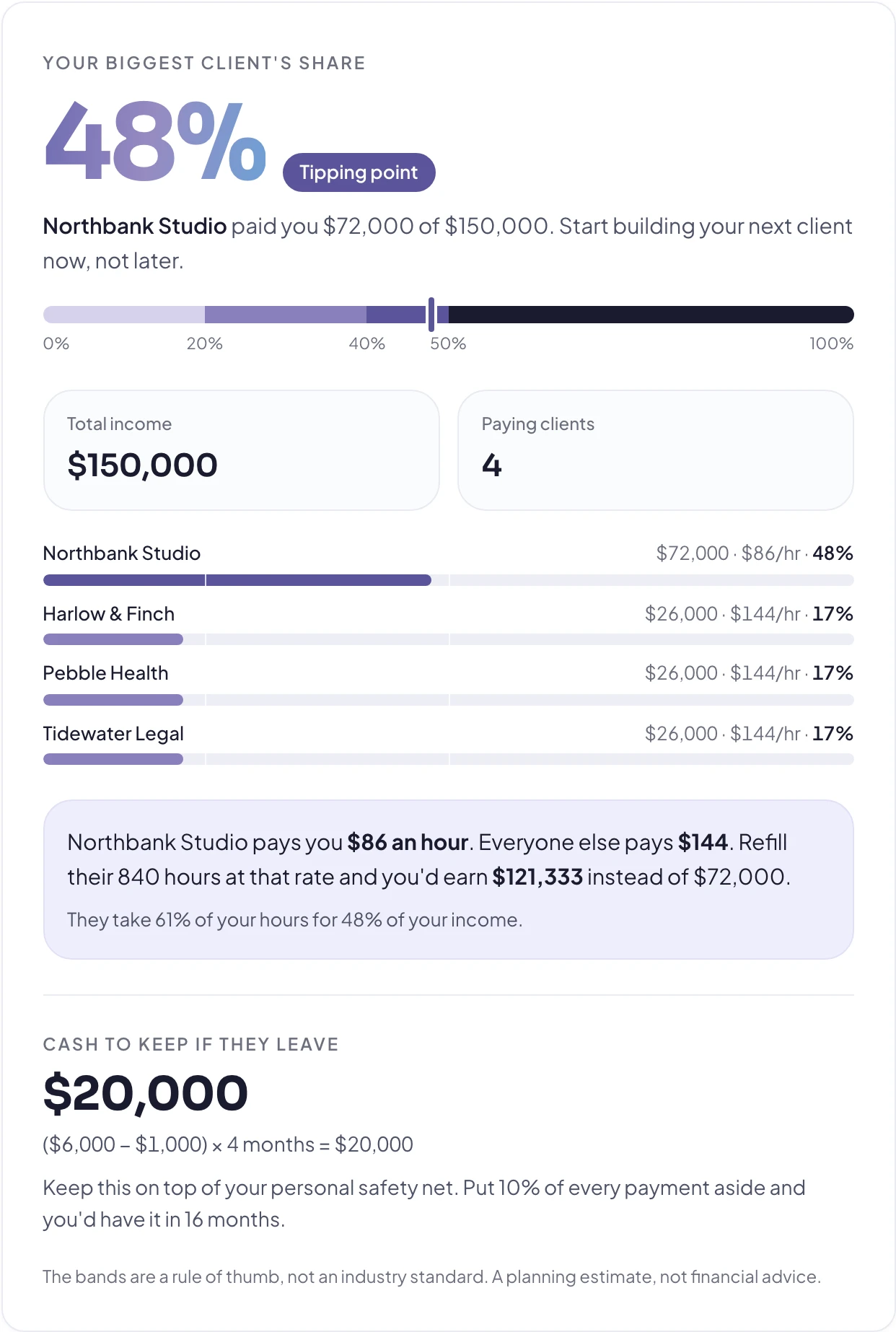
It saves your numbers in your browser, so update it each month with your income, and you'll always have a live view of how heavily you're relying on an income from one client.
Should you look at hours as well as revenue from each client?
Yes!
When a client is responsible for 48% of your income, it's natural to sweat a bit and feel the early stages of panic tingling in the pit of your stomach.
But before you reach full-blown anxiety, it pays to look at how much billable time your biggest client is taking up.
Let's say your largest retainer is 70 hours a month and pays $86 per hour, while your smaller clients take around 45 hours a month at $144 per hour.
Losing the retainer will cost you a chunk of income, but it also gives you back a chunk of billable hours. If you refill those hours at your $144 rate, your income will return faster, and you'll earn more money.
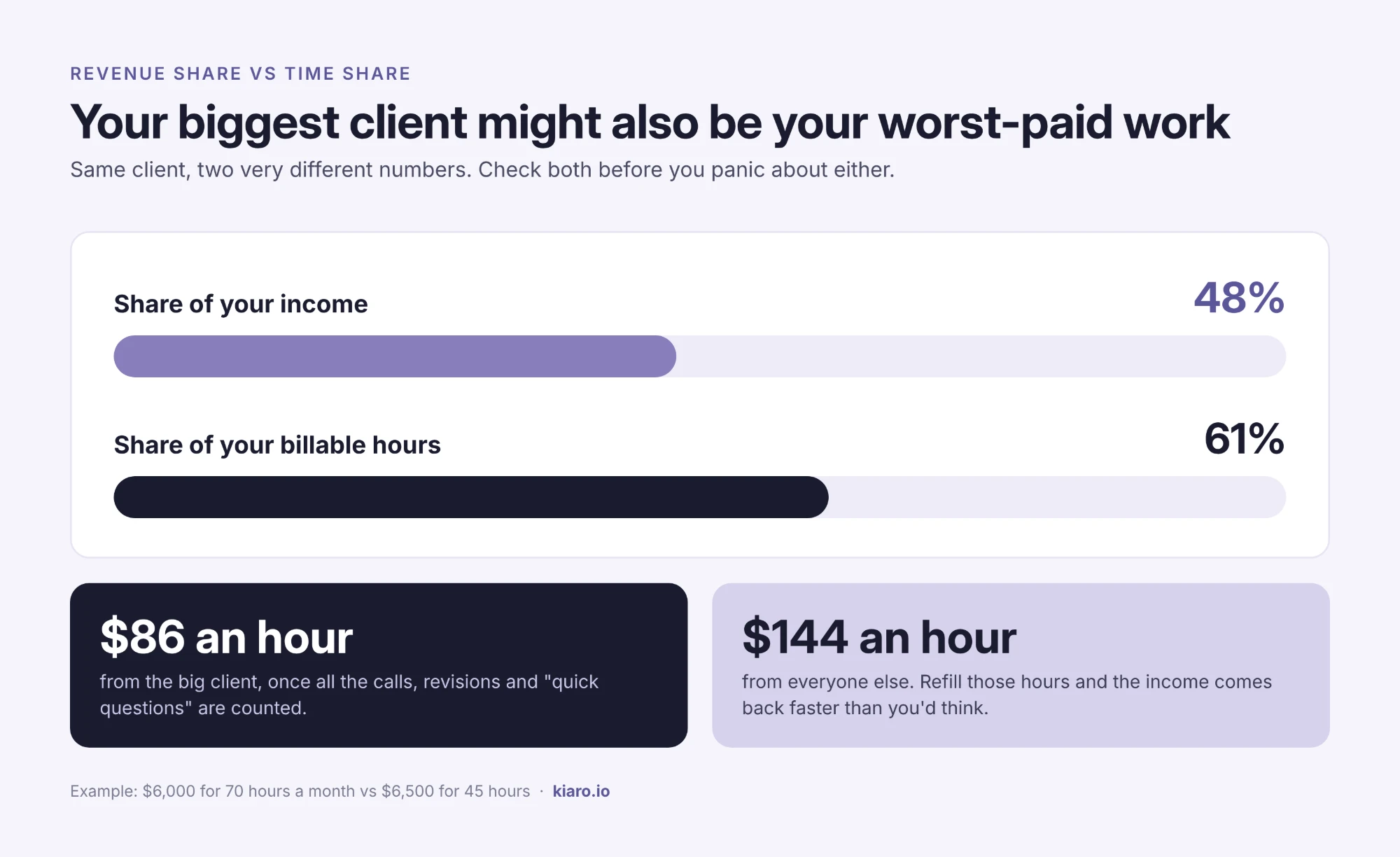
So as you review your current client roster, look at both of these numbers. If your biggest client gobbles up most of your time and pays you the least, that's a red flag. It's a sign to either renegotiate your rates or seriously consider firing the client and replacing the contract.
Read more: How to Offboard a Consulting Client
How much cash do you need in savings if your biggest client leaves?
It all comes down to, you guessed it, more maths!
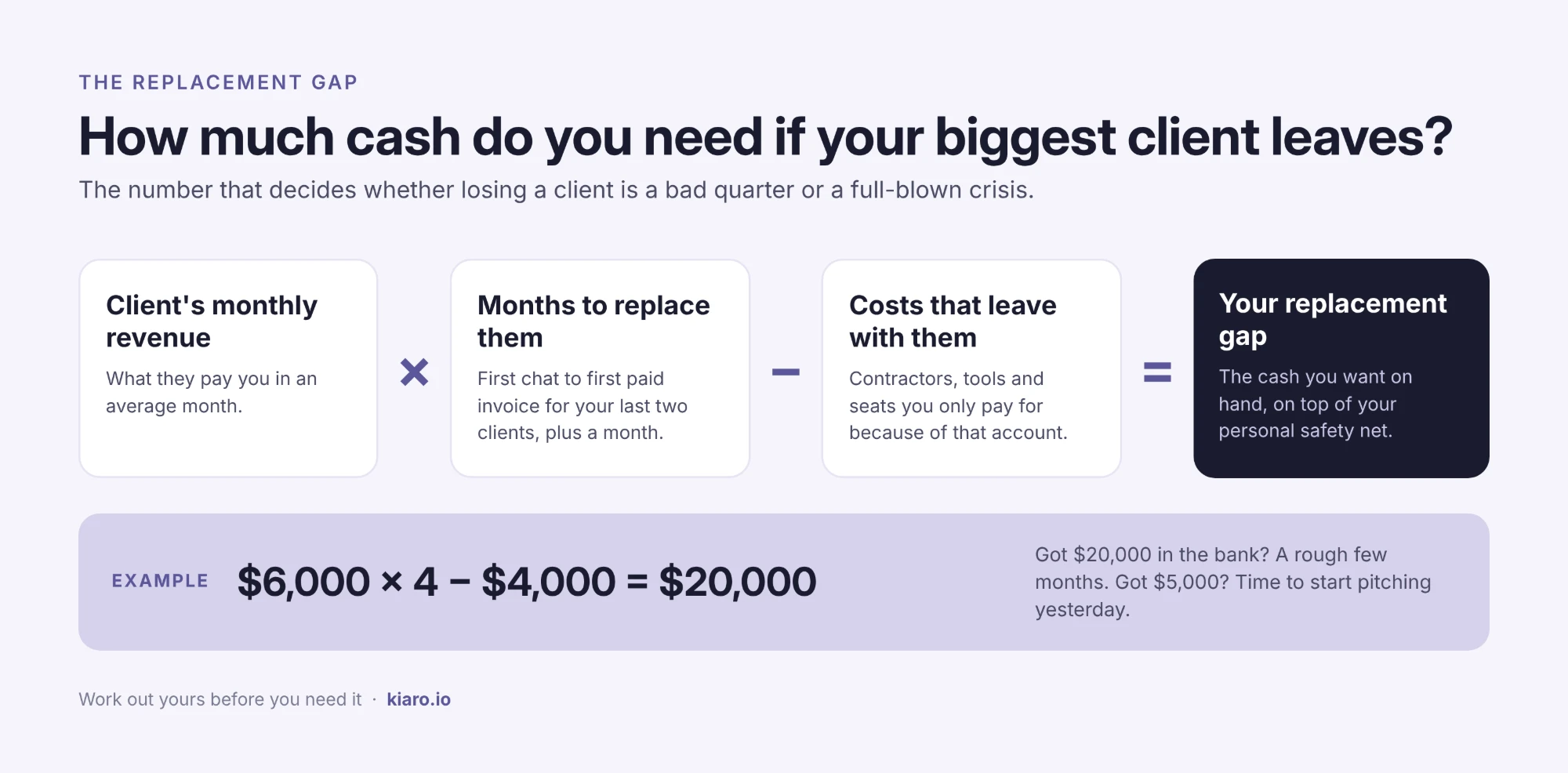
To work out how much of a cash cushion your business needs, you'll want to run the following replacement gap calculation:
Replacement gap = the client's monthly revenue × months to replace them − the costs that leave with them
Here's an example of what that can look like:
If your monthly revenue for your largest client is $6,000, it takes you 4 months to find new clients, and you pay a contractor $1,000 a month to help on their project, those $4,000 of costs leave with the client. You would need $20,000 in the bank.
A quick one.
Your replacement gap fund isn't a fancier term for an emergency fund. These funds should be on top of your personal safety net.
For the latter, the general rule is to keep three to six months of living expenses in a high-yield savings account you can access easily.
With both buckets, you've insulated your business from quiet months and the time it takes to convert a lead into an invoice.
A habit worth stealing: Put aside 10 to 15% of each payment into your replacement gap fund. You'll slowly build it up while you have cash coming in, and when a quiet period hits, you don't need to turn back to your two-minute noodles college days to get through the month.
What to do if one client is carrying too much of your income
The fix is to shift your hours away from your biggest client slowly. In the investing world, this is called "diversification". You want to set up other positions in the stock market so a single loss can't tank you.
In practice, your strategy to balance out your client portfolio could look like taking the following actions:
- Capping your whale: Instead of new hours going to your largest client, reallocate your time to other projects.
- Carving out time for lead generation and marketing: Keeping your pipeline full is step one to shrinking how many months it takes you to replace a contract.
- Updating the contract at renewal: Protect your income by adding notice periods, asking for deposits or kill fees on projects.
- Signing multiple mid-size clients: Diversifying your billable hours is the easiest way to reduce your reliance on one client, but managing multiple small accounts comes with an increase in non-billable hours. Aim for around 4 to 6 mid-size clients to balance diversification and workload.
Whether you've just lost your biggest client or you want to future-proof your business, doing the maths now is the best way to get ahead. Planning for the unexpected gives you room to calmly adapt instead of scrambling to react.
Sign up for Kiaro, free for your first three active clients, and discover how an all-in-one business operating system for freelancers can help you better manage a busy client load.
Frequently asked questions
What percentage of income from one client is too much?
A good rule of thumb is to avoid having one client responsible for more than 50% of your income. A safer bet is to keep each account around 20% and make sure you have a cash cushion large enough to cover the time it takes to replace a client.
How much should a freelancer keep in savings?
For personal savings, keep three to six months of living expenses easily accessible in a savings account. On top of that, you'll want a separate account with enough cash to cover your replacement gap: your biggest client's monthly revenue multiplied by how many months it would take to replace them, minus any costs that leave with them.
How many clients should a freelancer or solo consultant have?
Four to six mid-sized clients is a practical target, but not a hard rule. It gives you enough diversification to avoid any one client from dominating your income while also avoiding the admin of managing fifteen clients.