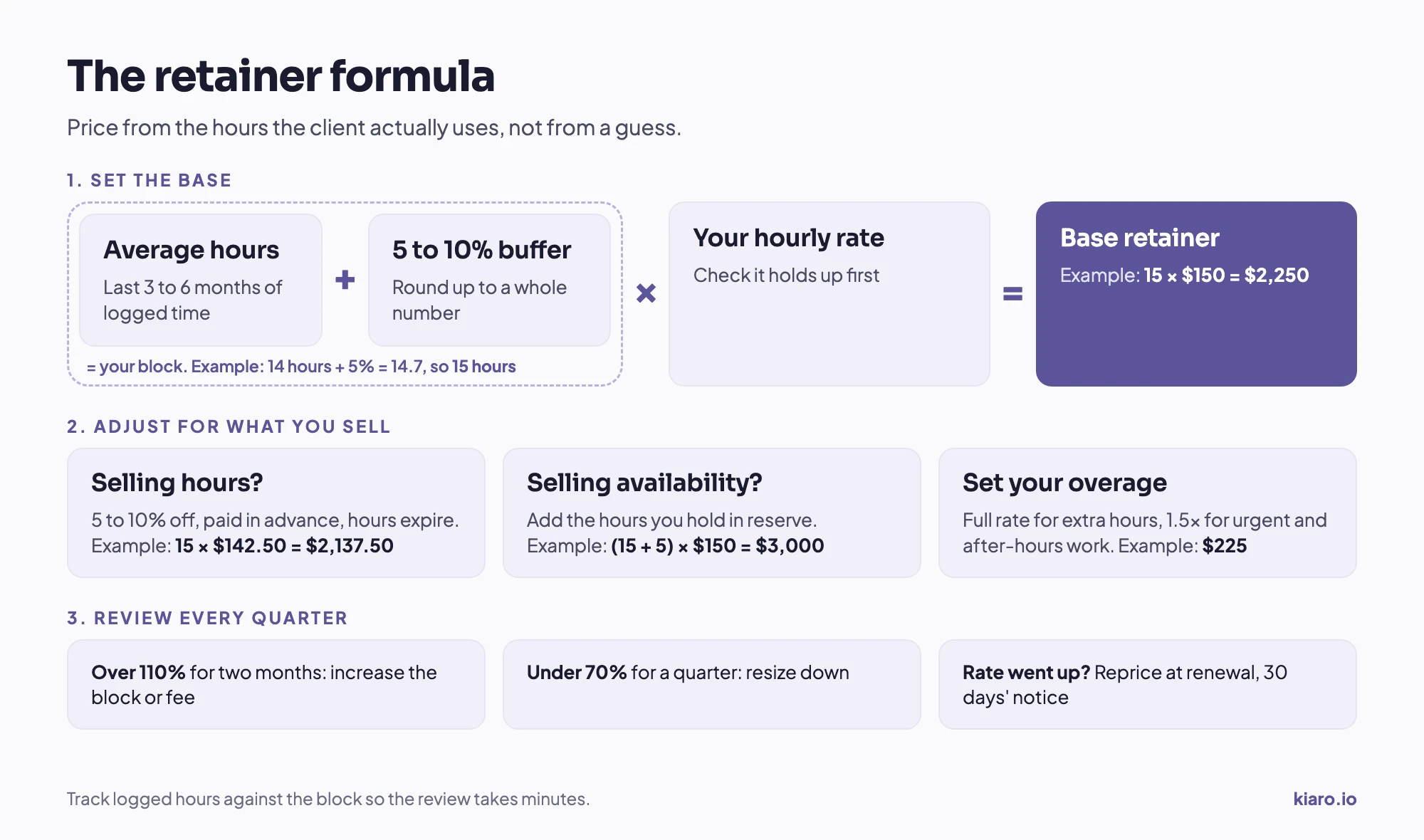
To price a consulting retainer, first decide whether you're selling hours or availability. Then size the block from your logged hours, similar clients or the scope, add a 5 to 10% buffer, and multiply by your rate. Discount hourly retainers by 5 to 10%, charge a premium for availability, and bill overage at your full rate.
"Can we put you on retainer?"
Six sweet, sweet words to anyone running their own business.
A retainer means predictable monthly income, a real weight off when you're the one keeping everything afloat.
The only hiccup? Figuring out how to price a consulting retainer.
Price it too low, and you're working 20 hours for a 15-hour fee. Sell too big a block with rollover hours, and you end up overcharging and at risk of the client cashing in all those unused hours at once.
The trick to making any retainer work is finding the sweet spot between your value, time, and client expectations and landing on a number that won't come back to bite you.
Below, we'll go over the maths together and help you decide what you're selling, choose the right block size, set your rates, and pick a rollover rule.
What are you selling: hours or availability?
Your answer is the first building block of your consulting retainer.
If the work is predictable (e.g. monthly reporting, ongoing design support, a weekly strategy session), sell hours. Your client is buying your time in bulk.
But if it's unpredictable and urgent (e.g. systems support, after-hours crisis management, compliance questions), sell availability. Your client is buying a reservation of your time and a guarantee you'll respond quickly.
Can you mix both? Yup! As long as everything is detailed in your contract and statement of work.
Read more: Hourly Billing Guardrails: Clauses and Change Orders to Prevent Scope Creep
Should a retainer cost more or less than your hourly rate?
An hours retainer should cost a little less than your hourly rate. An availability retainer should cost more.
We suggest a 5-10% discount on an hourly retainer, but with a few strings attached. The hours expire each month, and the client pays for your time in advance.
Without these conditions, you're working cheaper, not smarter.
An availability retainer is a different story. You're no longer selling hours you work. You're selling capacity. If promising a one-hour response window means keeping five hours a month free, blocking your time costs you money whether work comes in or not.
Which means you need to charge a premium for the hours you can no longer sell.
Here's how both retainers could look in practice:
| Hours retainer | Availability retainer | |
|---|---|---|
| Hours included | 15 | 15 (+ 5 hours in reserve) |
| Rate | $142.50 (5% off) | $150 |
| Monthly fee | $2,137.50 ($142.50 x 15) | $3,000 (20 x $150) |
| Response time | Normal working hours | Within one hour |
| Unused hours | Expire monthly | Expire monthly |
| Overage | $150 an hour | $150 an hour, $225 after hours |
How many hours should your consulting retainer include?
The size of your retainer block all comes down to your data (or lack thereof).
If your existing client wants to move onto a retainer
Pull up your time log from the last three to six months. What you want to find is the average number of hours you spend on the project each month. Then, add a 5% to 10% buffer and round up to a whole number.
Why the buffer? It stops a month or two from tipping into overage and feeling like a bait-and-switch.
Here are a solo consultant's hours at $150 per hour:
| Month | Hours logged |
|---|---|
| June | 12 |
| July | 16 |
| August | 11 |
| September | 18 |
| October | 13 |
| November | 14 |
The average number of hours is 14. Add a 10% buffer, and that's 15.4, rounding up to 16 hours.
If the client is new, but the work isn't
Done the same work for other clients? Good news! You already have the data to do the maths.
If your last three content strategy clients each took 10 to 14 hours a month, create a retainer at 12 with a small buffer.
Once you have your number, run a sense check against the client's wish list. How many calls, reports and requests do they expect and how long would each task take you?
If you're new to consulting with no data to go on
Never fear! You can build your number from the scope.
List what the client wants each month, put an honest time estimate against each item (use a time tracker to help), add it all up and then add your 10% buffer.
To protect yourself from under- or overcharging, include a review of retainer billing in your contract after three months. It turns your estimate into a starting point and allows you to adjust your rate instead of waiting until the end of a contract.
Read more: A Consulting Retainer Agreement Template for the Newly Solo
What should you charge when a client's hours go over?
Use your full rate. Every time.
It's tempting to offer a discount when you're worried about losing a client. We've all been there, but it never pays off.
Remember, the hourly rate discount is a reward for committing to the retainer block. Any hours beyond your initial agreement haven't earned it.
For after-hours and urgent work, you should charge a premium. A good rule of thumb we use is 1.5x your rate. So if you charge $150 per hour, your new rate would be $225.
If you're consulting alongside a full-time job, protecting your time is even more important. Every after-hours call comes out of the few evenings you have to yourself, meaning your time should never be on sale.
Tip: Never wait until overage happens to bring it up with a client. Before work begins, agree in writing how you will handle additional hours. For example, a client could buy a second block early, pay a one-off overage fee, or move some work to the following month.
Read more: Quiet Scope Creep Fixes for Consultants on Retainers
Should your unused retainer hours roll over?
Yes and no.
It depends on how you want to run your consulting business, but an unlimited rollover is where a retainer can go awry.
Let's say your client buys a block of 15 hours for 6 months. By the end of month four, you've used only 32 of your 60 hours, so 28 are still in the bank. Now, the client wants to use the full 15 hours plus the 28 hours in reserve in one month.
You're now doing nearly three months of retainer work for one month's fee.
Yikes.
To avoid a situation like this and keep things fair for your clients, there are two structures you can use:
- Use it or lose it: Retainer hours reset every month.
- Capped rollover: Up to a quarter of the block carries into the next month and only then expires.
But what if a client doesn't use all of their hours in a month?
Be honest.
If someone is using less than 70% of the block, it's possible the workload was underestimated. The right thing to do is suggest a smaller retainer or other tasks you can do to fill the hours.
It does mean you might earn less, but no one wants to overpay for a service.
Read more: How to Handle Late-Paying Clients
When is it time to reprice your consulting retainer?
Build a habit of checking your retainers every quarter. Without reviewing your time-tracking data, it's hard to know whether you're undercharging.
- Over 110% of retainer hours for two months running: Increase the block, the retainer fee, or both.
- Under 70% for a full quarter: Resize down or switch from an hourly to an availability retainer.
Lastly, when the retainer is up for renewal and your rates have increased, you'll want to give your clients 30 days' notice of your new pricing.
And the billing saga of it all?
Try Kiaro. An all-in-one hub for running your consulting business.
Retainer billing is built in on every plan (including Free, for your first three active clients!). Set your monthly fee, include the hours and an overage rate, pull in your logged billable time, and watch the client's available hours count down. Once you hit 85%, the system flags it.
Once you connect an AI app to Kiaro, you can ask it about your invoices and unbilled time, and have it prepare drafts for you, saving you even more time.
Bada bing, bada boom!
Frequently asked questions
What should a retainer agreement include?
At a minimum, your retainer agreement should cover the scope of work (including what's out of scope), the hours or availability included, the monthly fee and response times. It should also set your overage rate, what happens to unused hours, payment terms, a review after the first three months, and the contract term and notice period.
Is a retainer better than project pricing?
It depends on the work you're doing for a client. For ongoing projects with an unpredictable scope, a retainer works well. For a defined deliverable with an end date, project pricing makes more sense. Depending on the client, you could run a retainer for support and quote projects separately.
Is a retainer better than hourly billing?
It depends on how regular the work is. Hourly billing suits one-off tasks and clients who need you now and then. A retainer works better for ongoing monthly work, because you get predictable income and fewer invoices to chase, and the client gets a fixed budget and guaranteed access to your time.
How long should a consulting retainer agreement run?
Most consulting retainers start on a three-month initial term. From there, you could switch to month-to-month with 30 days' notice or work on longer terms like six or twelve months depending on the scope of work.
Should you bill a consulting retainer in advance or in arrears?
Bill the monthly fee upfront and any extra hours at the end of the month. That's because the client is reserving your time ahead of the month.